HP - Ambuja Cements Mangalore Factory Visit
The team connected with the Mangalore Subdivision of the Ambuja Cement factory for a fieldwork visit. The key objectives for the visit are to gain further insights into the current manufacturing process and collect data regarding the environmental and economic impact of the current industry practices concerning - carbon footprint, resource depletion and the cost implications of the traditional methods. We connected with Mr. Sudheesh, the current head of the Kochi Subdivision of Ambuja Cements, who was enthusiastic about the opportunity and put us forward to Mr. Lloyd Dsouza, the head of the Mangalore Subdivision. He was open to inviting the team to visit the factory and meet the technical department after the arrival of their factory-grade PPE kits (post-February 20th).
Sponsorship - Ambuja Cements
Upon hearing the team's research idea, Mr. Lloyd Dsouza, head of the Mangalore Subdivision of Ambuja Cements, suggested an opportunity in terms of funding the team upon the confirmation of the research project. We are to keep him in the loop regarding the advancements of our project through the official mail after the factory visit.
Education and Outreach - Comic Strip
To raise awareness regarding our project, we have created a series of comic strips that explains the need and aim of our project in simple and comedic terms. These comic strips woud be displayed during our educational events and on our social media handles.
Survey on project's impact
The aim of the survey was to gauge public insight regarding the impact of our project and the usage of desert sand as an alternative to riverbed sand in cement production; by circulating it to people of various demographics. Through this survey, we were able to assess public awareness and support for our approach and its impact in terms of sustainability and the global housing crisis.
We received roughly 170 responses in 24 hours, with a majority of the participants expressing enthusiasm for our project. Attached below are the insights into the response statistics -
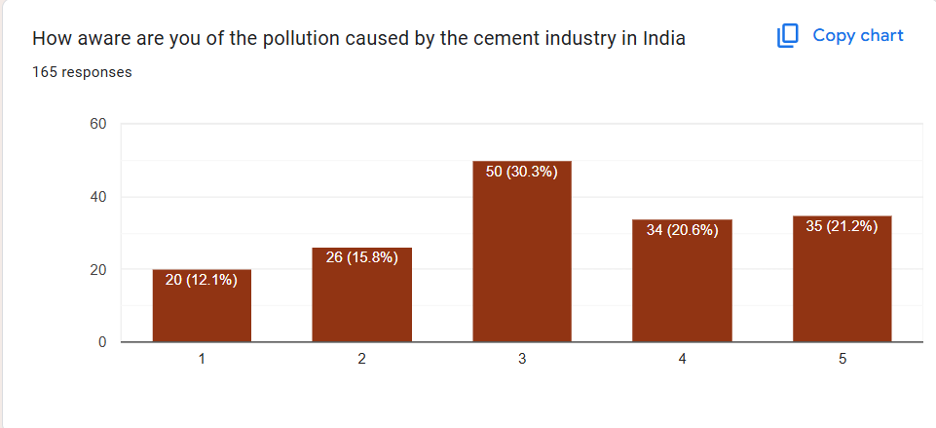
Roughly 72% percent of the participants were aware of the pollution caused by the cement industry in India, with 5 being labelled as Highly Aware and 1 being Unaware.
.png)
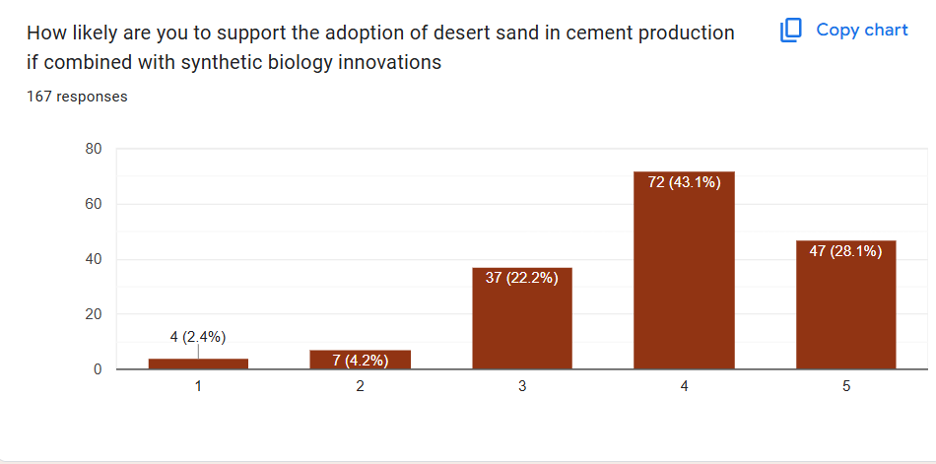
With respect to these 2 bar graphs, it is evident that the public is open to adopting desert sand in cement production with bioengineered elements and believe that sand degradation is a growing problem which causes major devastation to rivers, our lifelines and hence voted that it is crucial to find sustainable alternatives to riverbed sand in the development of cement.
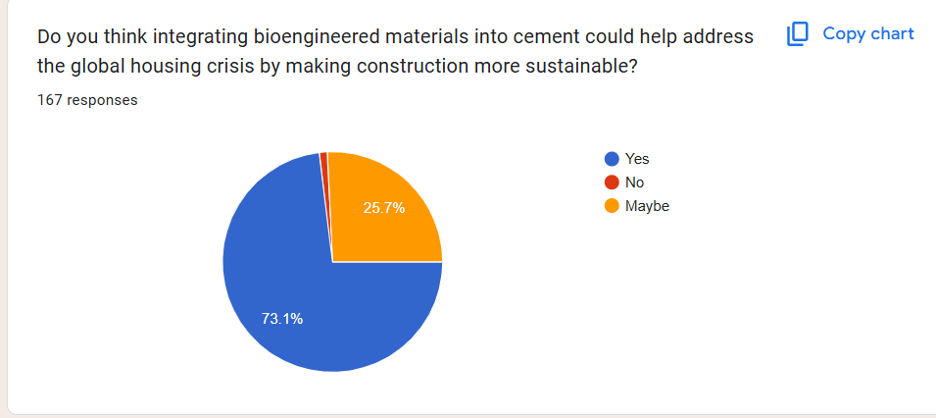
Lastly, about 73.1% of respondents believe that cement integration with bioengineered materials can be a transformative solution for the global housing crisis. This shows the potential of sustainable innovations in mitigating environmental challenges and meeting social needs, such as affordable and sustainable housing.
Conclusion
The results of this survey show an endorsement of including bioengineered cement with desert sand and the synthetic biology technologies in the cement industry. Enthusiasm of the public in sustainable solutions together with the strong need to restore riverbed sands and solve the housing crisis ensures that our project is relevant and impactful.
Our project, applying synthetic biology to develop a sustainable, strong, and scalable alternative to traditional cement, supports global priorities on sustainability and housing. These results make us even more confident in the pursuit of this initiative and expose its potential and capabilities for revolutionizing the construction industry while focusing on critical environmental concerns at this moment.
Documentary-Style Video Outlining Problem Statement of Our Project
Goal
By using storytelling methods similar to well-known educational TV shows (such as Ancient Aliens), the documentary-style video seeks to visually convey the team's project's varied impact. Through creating a video we believe that it will have better reach and public engagement which will increase awareness about our problem statement in the general public. In addition to increasing awareness at investor meets, scientific conferences and melas that the team would attend & educational visits.
Important Aspects & Design of the Video
1. Format & Tone:
Narrative-Driven: To ensure the documentary will not just consist of scientific jargon, we will be explaining difficult concepts in an easy-to-understand format, by bringing up appealing stories with scientific explanations.
Visual Engagement: To replicate the pacing and fascination of History Channel documentaries, use archival video, dynamic editing, animations (such as computer-generated imagery for technical operations), and reenactments.
2. Production Schedule:
Pre-production (three weeks) includes preparing for interviews and script writing and refinement.
Production (roughly two weeks): Voiceovers, b-roll (labs, expos, and simulations), and interviews are filmed.
Lastly, two weeks of post-production include sound design and insertion, editing and final review.
3. Distribution:
i. Main Channels
a. Wiki (Homepage)
b. Expos + QR code
c. Social Media - MBM page on Instagram & Linkedin
ii. Partnerships
To increase reach, we could potentially work with relevant organizations in the field/educational partners.
iii. SEO Optimisation
We would use keywords such as "innovation impact," "project documentary," and terms unique to our video and problem statement both in the title and description (will also be using hashtags).
Future Plans
The team plans on conducting further iHP & HP sessions to gather more insight regarding the different aspects of the project including bioreactor design and development, modeling and software usage, studying the interaction between our sand grains and microorganism and the commercial applications of our project.
Linked below is a list of potential contacts we will attempt to schedule interviews with.
https://docs.google.com/spreadsheets/d/1-BYUq8PWuE1D8ohzRTq82HxsnCRUI8G3s-4Kamj3XtU/edit